
How Much Does a Custom Website Cost for Small Business in 2026?
How much does a custom website cost for small business 2026? Real price tiers, hidden fees, and how to pick the right budget for your goals.
If you are asking how much does a custom website cost for small business 2026 budgets, the short answer is $5,000 to $25,000 or more for a genuinely custom build, with most small businesses landing in a $6,000 to $15,000 band. That range is wide because "custom website" covers everything from a sharp eight-page service site to a booking system wired into your CRM.
What almost no pricing page tells you is how to turn "I have $8,000" into a decision. Below we name the scope questions that move a quote from $2,000 to $9,000, give you an eight-point checklist for reading quotes line by line, and say plainly where a template beats a custom build.
How Much Does a Custom Website Cost for Small Business 2026: The Real Range
A custom website is designed and built for your business from the ground up: original layouts, your content structure, and code or a content management system configured around how you actually sell. It is not a $19-a-month builder template with your logo dropped in.
For that kind of work, expect the following in 2026. A professional freelancer building a custom WordPress site typically charges $2,000 to $8,000, while agencies commonly quote $10,000 to $35,000 for a small business site, with complex ecommerce starting around $20,000, according to Elementor's small business website cost breakdown. A large custom site can cost $10,000 or more, GoDaddy's website cost guide notes, against roughly $120 per year for a basic builder-based site.
Put those together and the honest working band for most small businesses commissioning a true custom build is $6,000 to $15,000. Below $5,000 you are usually buying a template implementation, not custom design. Above $25,000 you are usually buying software, not a website.
If the quote you are holding is under $2,500 and the word "custom" appears in it, ask what is actually being customised. In most cases it is colours, fonts and a logo on a purchased theme. That can be a fine purchase, but it is a different product at a different price.
Scale matters too. Only 12% of US small business websites are built with custom full-code development, while 41% use no-code builders such as Wix or Squarespace, per survey data compiled by Digital Applied. Custom is the minority choice, and that is not a failure of the majority. It is a signal that most businesses do not need it until they do.
Custom vs. Template vs. DIY: Which One Are You Actually Pricing?
Most price confusion comes from comparing three different products as if they were one. Before you collect quotes, confirm which of these you are buying, because the custom website cost for a small business only makes sense next to its alternatives.
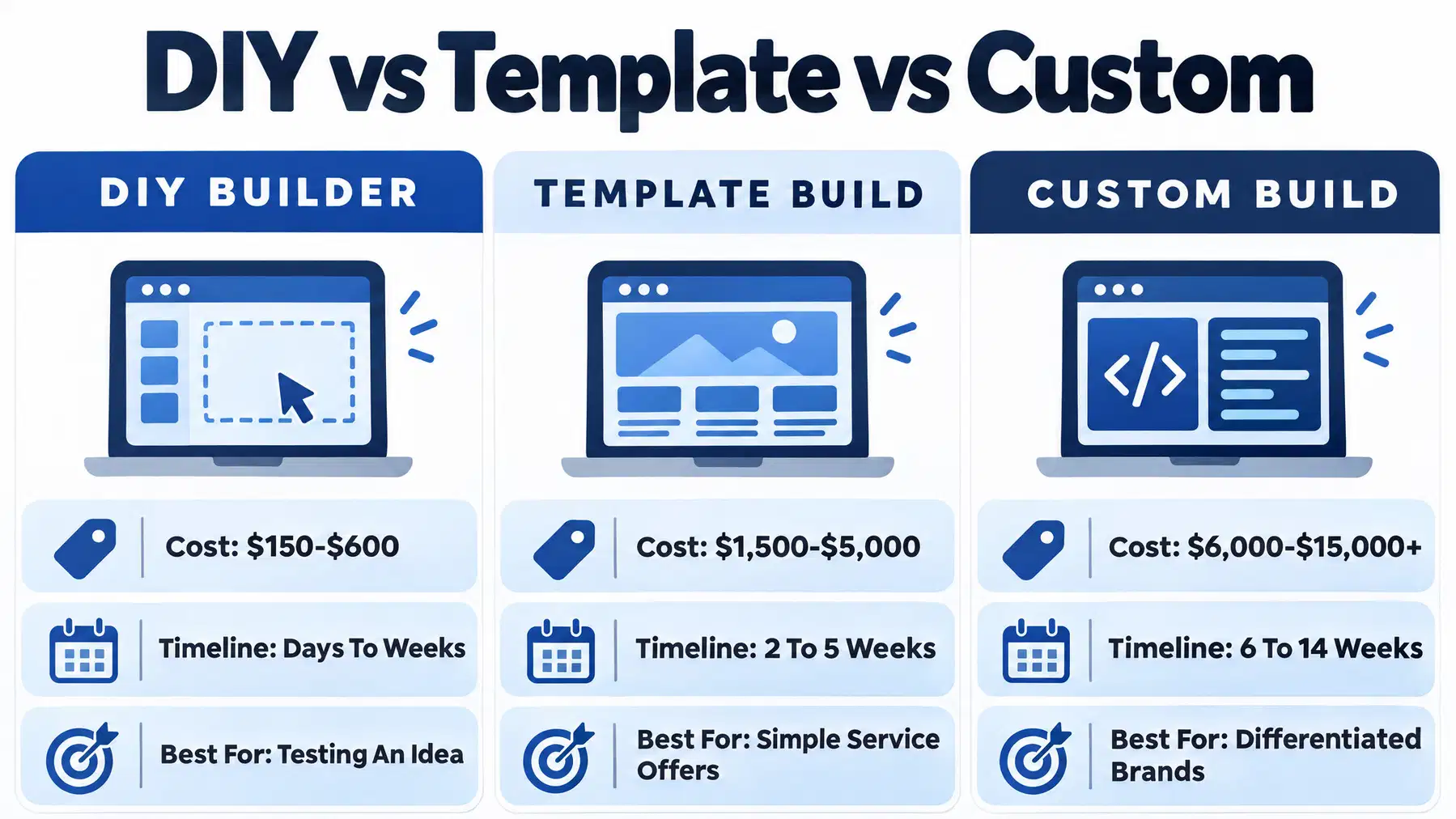
DIY builder. You pick a template and do the work yourself on Squarespace, Wix, Shopify or similar. You pay a subscription and your own time. Design quality is capped by the template, but the speed is real.
Template or theme implementation. A professional buys a premium theme and configures it for you: your content, your colours, light layout changes. Faster and cheaper than custom, and for a straightforward five-page service business it is often entirely sufficient.
Custom build. Layouts are designed for your content and your conversion path, not retrofitted. The content management system is built around how your team updates things. Custom functionality, integrations and automation are possible because nothing is locked by a theme's assumptions.
| DIY builder | Template build | Custom build | |
|---|---|---|---|
| Typical first-year cost | $150 to $600 | $1,500 to $5,000 | $6,000 to $15,000+ |
| Who designs it | You, inside a template | A pro, inside a theme | A designer, from scratch |
| Timeline | Days to weeks | 2 to 5 weeks | 6 to 14 weeks |
| Who updates it later | You | You, mostly | You for content, a developer for structure |
| Best for | Pre-revenue, testing an idea | Clear, simple service offers | Differentiated brands, integrations, scale |
If your honest answer is "I need a credible five-page site and I have $2,000," a template build is the right buy and no agency should talk you out of it. Read on anyway, because the quote-vetting section applies to template quotes too.
What Drives a Custom Website Quote From $5,000 to $25,000+
A quote is not priced per page. It is priced per decision. Here are the levers that actually move the number, and which ones you can negotiate.
| Cost driver | Typical impact on price | Negotiable? |
|---|---|---|
| Unique page designs (not total pages) | Each new design adds meaningfully; duplicate layouts add little | Yes, reduce by reusing templates |
| Copywriting | Often $1,500 to $4,000 if the agency writes it | Yes, supply your own |
| Custom functionality (booking, portals, calculators) | Adds thousands per feature | Partly, phase it |
| Ecommerce | Largest single jump; catalogue size drives it | No, if you need to sell online |
| Brand and design system work | Adds if you have no usable logo, palette or type system | Yes, if your brand is already solid |
| Third-party integrations (CRM, email, scheduling, payments) | Adds per integration | Partly |
| Revision rounds | Each extra round adds time | Yes, agree a number upfront |
| Content migration from an old site | Scales with page count | Yes, you can migrate it |
| Discovery and strategy phase | Adds up front, usually saves later | Rarely worth cutting |
The most misunderstood line is unique page designs. A 30-page site with six layouts costs far less than a 10-page site where every page is bespoke. If your budget is tight, cut layouts before you cut pages.
The second most misunderstood line is content. Many owners assume copy is included. It is frequently the single largest variable between two quotes for the same site, and it is the one you can most easily take in-house if you have someone who can write.
Why Two Custom Website Quotes Can Differ by $10,000 (And How to Compare Them)
Two agencies can quote the same small business $6,500 and $17,000 and both be fair prices. The gap is almost never greed. It is scope that nobody wrote down. Before you compare any numbers, ask every bidder for these eight line items in writing.
- Discovery and strategy. Is there a paid phase where someone maps your goals, audience and conversion path before design starts? A quote with no discovery is cheaper because it is guessing.
- Unique templates vs. total pages. Ask: "How many unique page designs does this include, and how many total pages?" A quote for "10 pages" with three templates is a different product from one with ten.
- CMS vs. page builder. Will you get a properly structured content management system, or a visual page builder? Builders are quicker to produce and slower to maintain at scale. Both are legitimate; the price should reflect which you got.
- Revision rounds included. Two rounds at design and two at build is a normal standard. "Unlimited revisions" usually means the price has padding in it for the ones you will use.
- Copywriting. Included, edited or entirely yours? Ask who writes the homepage. This single answer can explain a $3,000 gap.
- SEO setup depth. There is a large difference between "we add title tags" and keyword mapping, schema markup, internal linking structure and page speed work. Ask for the specific deliverables.
- Third-party integrations. List every tool the site must talk to: CRM, email platform, booking, payments, accounting. Make the bidder price each one. Assumed integrations are the top source of mid-project change orders.
- Post-launch support window. 30 days of bug fixes is standard. 90 days plus training is better. No support window means your first post-launch problem arrives as an invoice.
Get three itemised quotes using that list, then put them side by side on the eight rows rather than on the total. You will often find the "expensive" quote is cheaper per unit of work, and the cheap one has quietly moved copywriting, SEO and support off its own balance sheet and onto yours.
Red flag worth more than any price comparison: a provider who will not give you an itemised scope. The $1,200 build that costs the most is almost always the one that was never written down, because every disagreement later becomes a billable extra or an abandoned project.
Two more questions to ask before signing. Who owns the code, designs and domain at the end? And what happens if we stop working together halfway through? Both answers should be in the contract, not in an email.
Custom Website Pricing by Business Type and Complexity
Vague personas like "small business" are useless for budgeting. These bands are keyed to what the site has to do.
| Site type | Typical custom build range | What pushes it to the top of the range |
|---|---|---|
| Service business brochure site, 5 to 10 pages | $5,000 to $10,000 | Agency-written copy, photography, booking form |
| Multi-service or multi-location business | $10,000 to $18,000 | Location pages, service taxonomy, local SEO structure |
| Membership, portal or lead-heavy site | $15,000 to $25,000 | Logins, gated content, CRM sync |
| Ecommerce | $15,000 to $35,000+ | Catalogue size, variants, shipping and tax logic |
| Custom web application | $30,000+ | Anything that is really software with a website attached |
The jump that surprises owners most is automation. Connecting a site to a CRM, triggering follow-up sequences, routing leads, syncing bookings to a calendar and pushing data into a dashboard is real engineering. It can add $2,000 to $8,000 depending on how many systems are involved.
It is also, frequently, where the money comes back. If your team currently retypes every enquiry into three places, workflow automation built alongside the site usually pays for itself in recovered hours faster than the design does. Price it as an operations investment, not a website feature.
Freelancer vs. Boutique Agency for a Custom Build
Only 9% of US small business websites were built by a freelancer or consultant, while 45% were built by an agency, according to Clutch survey data. That does not make freelancers the wrong choice. It makes the match-to-scope question more important.
| Solo freelancer | Boutique agency | Large agency | |
|---|---|---|---|
| Typical custom build | $2,000 to $8,000 | $8,000 to $25,000 | $25,000+ |
| Strengths | Price, direct access, speed on small scopes | Strategy plus build, integrations, continuity | Scale, large teams, enterprise process |
| Watch for | Single point of failure, limited strategy or automation | Smaller capacity, booked out in advance | Account layers, minimum spends |
| Pick if | Scope is clear and small and you can self-manage | You need the site tied to how the business runs | You have multiple brands or markets |
A boutique, strategy-led shop sits in the middle on price and usually includes the things a solo freelancer cannot: planning before design, automation after launch, and someone still around in month six. That is the slot Kay's Consulting occupies, and it is the wrong slot if your need is genuinely a clean five-page brochure site for $3,000.
The Costs That Show Up After Launch
Your build price is not your website budget. Plan for the ongoing side from day one so it does not arrive as a shock in month two.
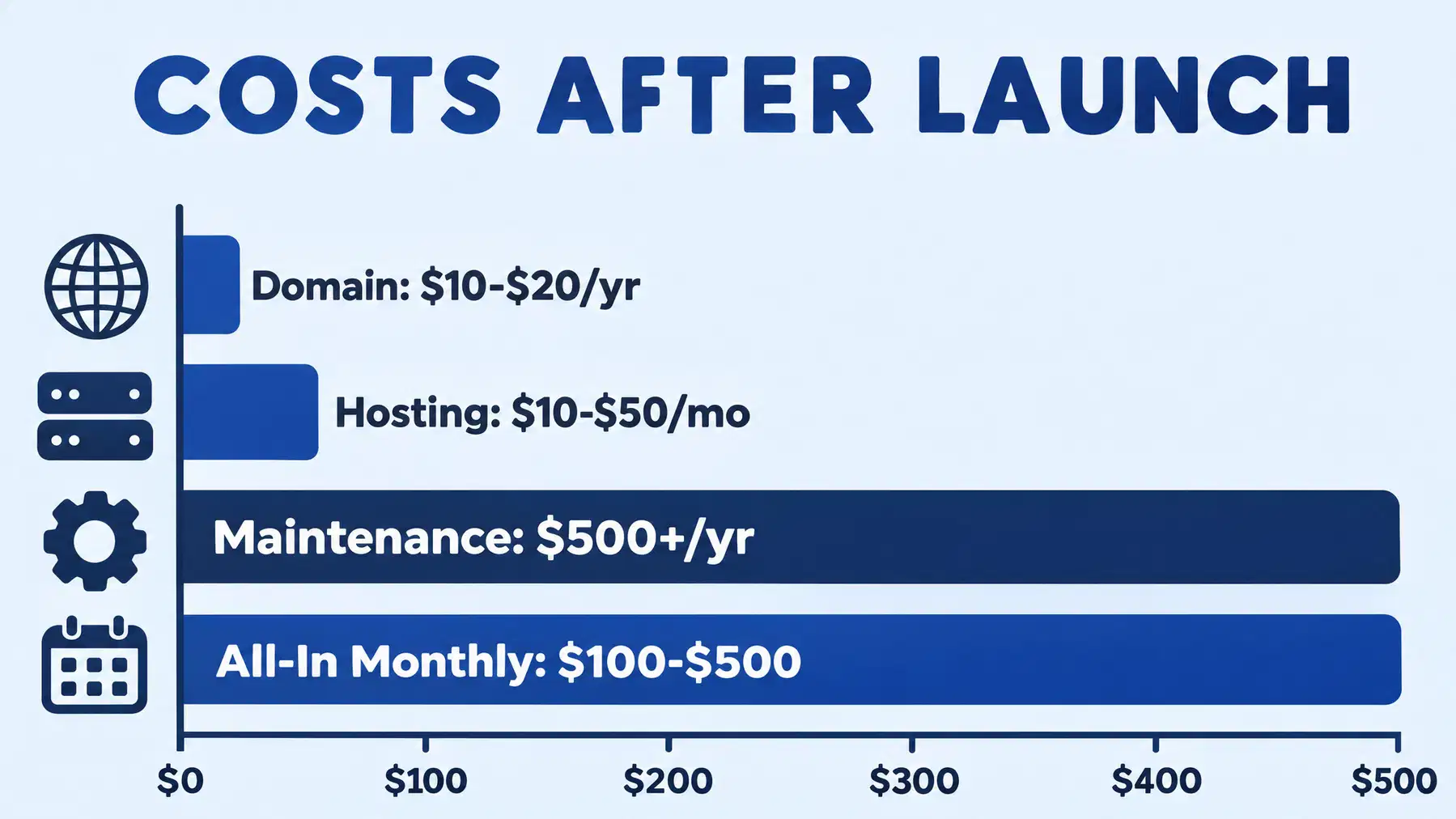
- Domain: roughly $10 to $20 per year for a standard .com.net or .org, per GoDaddy and Elementor cost guidance.
- Hosting: $10 to $50 per month for most small business sites, more for high-traffic or ecommerce.
- Maintenance and security: budget up to $500 or more per year for updates, security and backups, GoDaddy advises. Managed plans from an agency typically run higher.
- Content updates: either your time, or a retainer. Custom builds often need a developer for structural changes, unlike DIY builders where you can drag things around yourself.
- Ongoing SEO and content: the largest ongoing line for most businesses, and entirely optional in the short term.
A realistic all-in monthly band for a custom small business site is $100 to $500 per month for hosting, maintenance and light content support. Add SEO and content production and it commonly runs $750 to $2,500 per month, depending on ambition.
Always budget an extra 10% to 20% for the costs that are easy to forget: premium plugins, stock photography, professional email and licences, as Elementor recommends. These are small individually and add up to a real number.
Is a Custom Website Worth the Extra Cost?
Sometimes it is not, and you deserve to hear that before you spend. A template or builder is genuinely the better buy if you are pre-revenue or testing an offer, if your site's job is to look credible and list a phone number, if you have no brand assets worth protecting, or if nobody on your team will maintain anything complicated.
Custom starts to pencil out when one of these is true. Your site is a real part of how you sell, so a few percentage points of conversion improvement is worth thousands. You compete in a category where everyone looks identical and differentiation wins work. You need the site connected to your operations. Or you have outgrown a template and keep paying for workarounds.
That last one is common. 81% of US small businesses have redesigned their website at least once, and 90% plan to invest in their website, Clutch's survey of small business owners found. A cheap site you replace in 18 months is not cheap.
The honest ROI test is arithmetic, not aesthetics. Work out what one new customer is worth over a year, then ask how many extra customers the build has to produce to pay for itself. For a $10,000 build and a $2,000 customer, that is five. If five more customers a year sounds implausible from a better website, buy the template.
Where custom reliably earns its keep is the compound effect: a conversion-focused design, a brand that does not look like your competitors, and workflows that stop leads leaking. If you want that tied to specific targets rather than vibes, that is what strategy-led website design and development should deliver, and you should ask any provider how they will measure it.
How to Budget for Your Custom Website Without Overpaying
Here is the sequence that keeps a small business web design budget under control without buying something you will regret.
- Write down the goal in one sentence. "Book 15 consultations a month" prices differently from "look professional." Everything downstream follows from this.
- Split features into must-have and later. Be ruthless. Booking, payments and integrations are the expensive ones, so be sure each is a launch requirement rather than a wish.
- Audit what you already have. Usable logo, brand colours, photography, written copy and a product list all reduce the quote. Gaps are billable.
- Get three itemised quotes using the eight-point checklist above, and insist all three price the same scope. A quote that will not itemise is not a quote.
- Separate one-time from ongoing in your budget. Build cost in one column, monthly hosting, maintenance and marketing in another. Approve both at once.
- Add 10% to 15% contingency. Something will change. Projects that fail usually fail on money that ran out, not scope that was wrong.
- Phase what you can. Launch the brochure site, add the booking portal in month four, add automation in month eight. Phasing costs slightly more in total and dramatically less in risk.
One last piece of context. Labour quality and inflation were the top two problems cited by US small businesses in September 2026, according to Statista's survey. Those same pressures are why automating lead handling and admin alongside a rebuild often returns more than the design alone.
If you want a sanity check on the costs ahead of the site itself, the SBA's startup cost planning tools are free and worth an hour. And if you would rather talk through scope before collecting quotes, a boutique team that does strategy, build and automation together can usually tell you in one conversation whether custom is even the right call for you.
Frequently asked questions
What is the average cost of a custom website for a small business?
Most small businesses spend between $6,000 and $15,000 on a genuinely custom website, with the wider market running from about $5,000 to $25,000 or more. Freelancers typically quote $2,000 to $8,000 for a custom WordPress build while agencies commonly quote $10,000 to $35,000. Where you land depends mostly on unique page designs, custom functionality and whether copywriting is included.
Is it cheaper to hire a freelancer or an agency for a custom website?
A freelancer is almost always cheaper up front and is the right choice when the scope is small, clear and you can project-manage yourself. An agency or boutique firm costs more but includes strategy, integrations and continuity that a solo builder usually cannot offer. The real comparison is cost per unit of delivered scope, not the headline total.
How much does a 5-page custom website cost for a small business?
A custom five-page site for a service business typically runs $5,000 to $10,000, depending on how many of those five pages need unique designs. If the agency writes the copy, expect to be near the top of that range. If you supply finished copy and brand assets, you can often come in below it.
What are the hidden costs of a custom website build?
The usual surprises are premium plugins and licences, stock photography, professional email, content migration from the old site and paid revisions beyond the included rounds. Budgeting an extra 10% to 20% on top of the quote covers most of them. Ask each bidder in writing what is excluded, not just what is included.
How much extra does e-commerce functionality add to a custom website?
Ecommerce is the single biggest jump in a custom quote, often pushing a build into the $15,000 to $35,000 range and higher for large catalogues. The cost scales with product count, variants, shipping and tax rules, and payment integrations rather than with page count. A small, simple shop on an existing platform can be much cheaper than a fully custom storefront.
Is a custom website worth it over a template or website builder?
It is worth it when your website is a real sales channel, when differentiation wins you work, or when the site needs to connect to your CRM and internal workflows. It is not worth it if you are pre-revenue, testing an offer, or simply need a credible page with your contact details. Run the arithmetic: how many extra customers must the build produce in a year to pay for itself?
How much should I budget for SEO and content on a new custom website?
Treat SEO setup during the build as a separate line item and ask exactly what it includes, since "SEO optimised" can mean anything from title tags to keyword mapping and schema. Ongoing SEO and content production for a small business commonly runs several hundred to a couple of thousand dollars a month. It is genuinely optional in the first few months, so phase it in once the site is live and stable.
How long does a custom website take to build, and does timeline affect cost?
Most custom small business sites take six to fourteen weeks from kickoff to launch, with discovery, design, build and review each taking a few weeks. Compressed timelines usually cost more because they require overtime or extra people, while slow client feedback is the most common cause of delay. Agreeing review turnaround times up front protects both the schedule and the price.